

Beyond the myths: how Lithuania’s state forests are managed, protected and funded
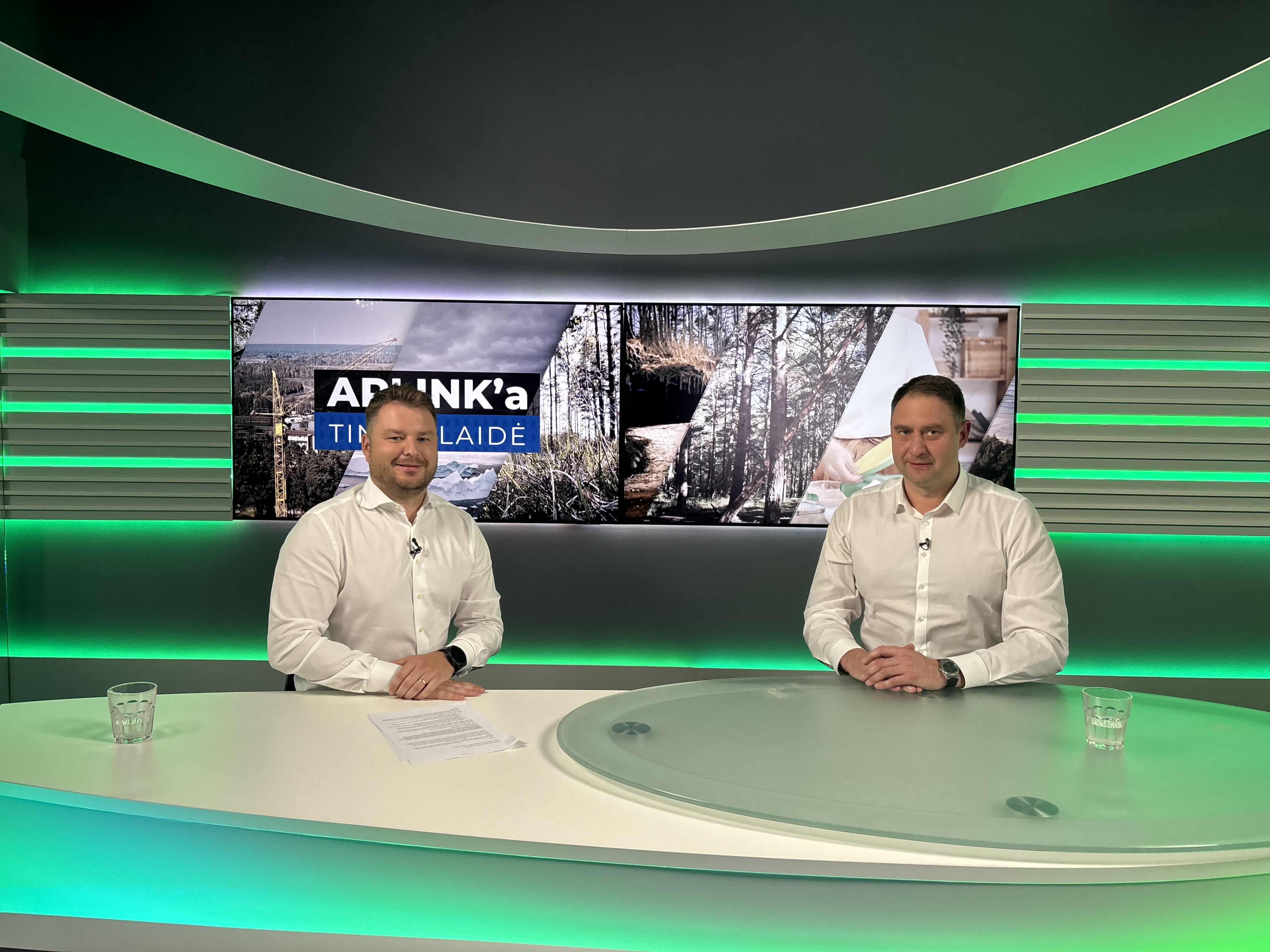
State forests account for around half of Lithuania’s forest area, so their management, harvesting and regeneration attract considerable public interest. Minister of Environment Kastytis Žuromskas and Valdas Kaubrė, Director General of the State Forest Enterprise, discussed how these decisions are made in practice in the Ministry of Environment’s podcast APLINK’a.
At the beginning of the conversation, Minister Žuromskas compared public interest in forests to Lithuania’s enthusiasm for basketball:
“Just as Lithuania has around three million basketball experts and supporters, it also has three million foresters.”
Mr Kaubrė noted that this level of public interest was understandable.
“Forests have a special meaning for everyone and are almost sacred to some people. As public interest in forests continues to grow, it is only natural that we need to explain more clearly what work is carried out there and why it is necessary,” said the Director General of the State Forest Enterprise.
Interest in forests increased particularly during the COVID-19 pandemic, when more people turned to nature and rediscovered educational trails and recreational sites. At the same time, the public began asking more questions about routine forestry operations, which start long before a mature forest stand is harvested.
Young trees are cared for from their first years. This is followed by tending and thinning of young stands, during which the most promising trees are selected. These measures create better conditions for forest stands to grow and develop.
Once a stand reaches maturity, regeneration fellings may be carried out in some areas. In other cases, felling may be required to remove trees damaged by disease, pests or extreme weather, maintain open habitats or implement nature management measures.
Following harvesting, forests must be regenerated within the period established by law. In state forests, the aim is to replant harvested areas as early as the following spring. New forest plantations increasingly combine several tree species, while naturally regenerated trees are retained where they have suitable conditions to grow. Greater species diversity helps create forests that are more resilient to climate change.
Forestry operations are planned through forest management plans covering ten-year periods. These plans are prepared after assessing the condition, age and composition of forest stands, protected natural values and applicable environmental requirements. They determine where and when tending, regeneration, recreation-related and other forestry work will be carried out.
Where protected species or other important natural values are identified in an area scheduled for work, the planned measures are reviewed and proposed fellings may be cancelled. Each case in a protected area is assessed individually, taking account of the specific location and the values protected there. As a result, activities may be restricted or modified, or supplemented by habitat management and work to restore damaged stands.
Information on planned and ongoing forest harvesting is publicly available through the felling map and databases maintained by the responsible authorities. In areas frequently visited by the public or located near residential settlements, information boards are installed before work begins and meetings with local communities are organised where necessary.
The management of state forests is also a large-scale economic activity requiring employees, machinery, contractor services and long-term investment. According to Mr Kaubrė, the State Forest Enterprise generates annual revenue of approximately EUR 280 million.
The Enterprise employs around 2,400 people, with annual staff costs amounting to approximately EUR 90 million. Around EUR 80 million is allocated to work carried out by contractors, while a further EUR 6 million is spent on public-interest activities and special obligations.
Operating on this scale requires continuous adaptation to changes in forest condition, public expectations and environmental requirements. Day-to-day working methods are also evolving. Drones, LiDAR technology and digital data are increasingly used for forest inventories, planning and monitoring.
These tools make it possible to assess the condition of forest stands more accurately and plan work that previously required more manual measurement. Changes are also taking place in timber harvesting, where equipment designed to reduce pressure on forest soils is increasingly used.
“It is encouraging to see that the State Forest Enterprise is keeping pace with technological developments and the latest practices. The forest sector is constantly changing and environmental requirements are becoming stricter. As a result, timber harvesting machinery is becoming smaller, lighter and more environmentally friendly,” said Mr Kaubrė.
The full episode of the APLINK’a podcast is available here:
Last updated: 26-06-2026
Related news:
Lithuania’s Social Climate Plan aims to improve living conditions for vulnerable people
Baltic States and Poland strengthen cooperation on implementing energy and climate plans
Key provisions of the EU Packaging and Packaging Waste Regulation now apply
Algirdas Pieniuta takes office as Vice-Minister of Environment