

Measures presented to increase housing supply and strengthen social and municipal housing systems
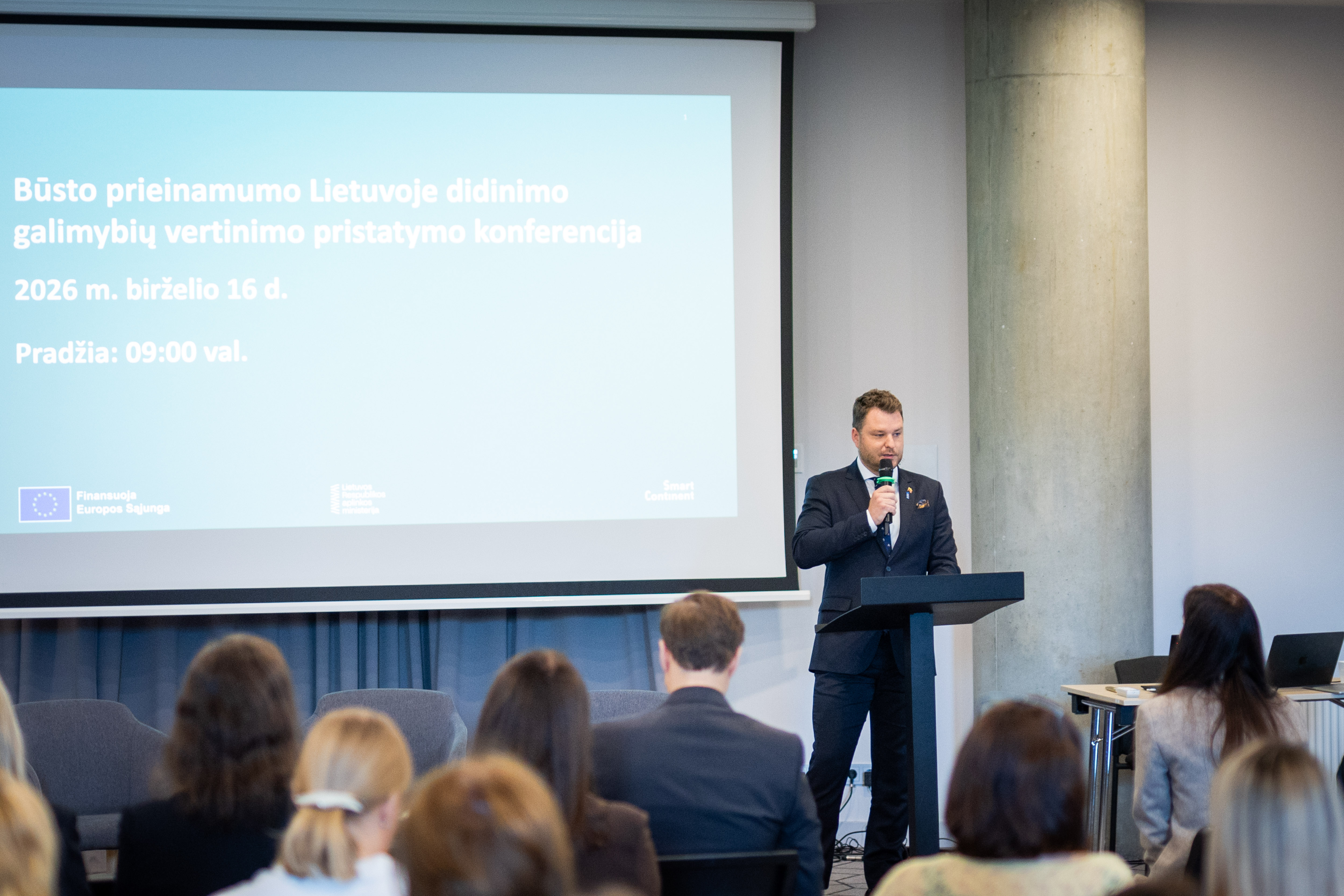
On 16 June, a conference organised by the Ministry of Environment presented the Assessment of Opportunities to Improve Housing Affordability in Lithuania. Participants discussed measures to increase housing supply and affordability and improve access to housing for socially vulnerable residents.
Experts in architecture, spatial planning, finance, real estate and law shared their insights alongside representatives of non-governmental organisations. The discussions focused on how public authorities, municipalities, the financial sector and housing developers could contribute to improving housing affordability.
During the first part of the conference, which focused on housing supply and availability, Mindaugas Statulevičius, President of the Lithuanian Real Estate Development Association, stressed that the public and private sectors must work together to find effective solutions. The proposals included expanding the municipal housing stock, introducing shared ownership models, developing state-commissioned rental housing programmes and using tax incentives to encourage long-term rental housing. Such measures could provide more options for residents who are unable to purchase a home under market conditions.
Urban planner Martynas Marozas noted that newly built housing remains unaffordable even for many middle-income residents. According to him, housing supply could be increased not only through new construction, but also by renewing older residential districts.
“A significant share of the potential for affordable housing lies in Soviet-era residential districts located further from city centres. Investment should be directed towards renewing these homes and ensuring their long-term quality. With appropriate architectural solutions, renovated housing could compete with newly built homes,” said Mr Marozas.
Housing affordability depends on more than the purchase price
The discussion also addressed the poor energy performance of buildings, which increases housing maintenance costs and reduces affordability. Lithuania has more than 2.5 million buildings, 23 per cent of which are residential. However, approximately 85 per cent of residential buildings fall below energy performance class D.
“To meet the European Union’s objectives, Lithuania will need to renovate more than 460,000 residential buildings by 2050. Appropriate architectural solutions are one way of creating high-quality and comfortable living conditions for residents,” said Laura Lukoševičienė, Head of the Housing Affordability Policy Group at the Ministry of Environment.
During the second thematic session, devoted to economic affordability, Nijolė Valinskytė, Director of the Financial Stability Department at the Bank of Lithuania, continued the discussion on housing quality. She noted that in some areas, prices for older homes are almost equal to those of newly built housing, even though new buildings are subject to stricter quality and energy performance requirements. Buyers do not always fully take these differences into account.
“When assessing the cost of purchasing a home, it is important to consider not only the purchase price, but also future maintenance and renovation costs,” Ms Valinskytė emphasised.
Housing market activity this year is 10 to 15 per cent above its long-term trend. As borrowing costs have fallen, the number of mortgage-financed housing transactions has increased, particularly in the largest cities. Rising demand is also placing upward pressure on prices. According to Ms Valinskytė, increasing housing supply is therefore the main way to moderate price growth. State support focused solely on stimulating demand will not solve the problem and may not be sufficiently targeted, as it can also benefit residents who are able to purchase housing without public assistance.
Cooperative housing could offer an alternative to individual ownership
Ignas Kazlauskas, urban planner and partner at the urban planning and architecture agency BLUMA, presented cooperative housing as an alternative to individual home ownership. Under this model, the building is owned by a non-profit cooperative rather than by individual residents. Residents receive the right to occupy a home, while their monthly payments cover the cooperative’s loan repayments, building maintenance and administration costs.
It was proposed that Lithuania test this model through a pilot project. A municipality could lease land or a building on favourable terms, while the state or municipality could provide a partial guarantee to the bank financing the project. Zurich, Switzerland, was presented as an example. Cooperative housing accounts for 18 per cent of the city’s housing stock, and rents are on average 30 to 50 per cent lower than on the commercial market.
“Cooperative housing is not merely a social policy instrument. According to representatives of the City of Zurich, its development strengthens the city’s competitiveness and improves its ability to compete with other cities,” said Mr Kazlauskas.
Social and municipal housing systems need to be strengthened
The discussion on economic affordability continued with an assessment of how housing could be secured for residents who cannot access market-based options. During the third thematic session, Evaldas Klimas, Partner at the law firm WALLESS, presented the challenges associated with the management of social and municipal housing.
“Lithuania is party to international agreements recognising the right to adequate housing, and the state must therefore work to ensure that this right is protected for all groups in society. Social housing is intended for the most vulnerable residents. Alongside it, however, municipal housing is also needed for a broader group of residents who do not meet the eligibility criteria for social housing but still face serious difficulties securing a home under market conditions,” said Mr Klimas.
Municipally owned housing accounts for approximately 1 per cent of Lithuania’s total housing stock, compared with an average of around 7 per cent across OECD countries. According to 2025 data, more than 10,000 people are waiting for housing rental support.
Increasing the number of social housing units alone will not be enough. Mr Klimas stressed that municipalities need stable funding to acquire, construct and maintain housing, clearly allocated responsibility for its administration and long-term planning based on residents’ needs. Concentrating social housing in a single area can increase segregation and stigma, so it should be distributed across different parts of a city.
The perspective of non-governmental organisations was presented by Arūnas Survila, Programme Manager and Founder of the National Institute for Social Integration. He noted that municipal social support and asset management departments do not always work in coordination and that the current system struggles to respond when demand for housing increases suddenly.
Possible solutions included expanding supported housing, adapting unused public property and allocating a share of homes in new developments for municipal needs. It was also proposed that municipalities be given greater flexibility to select measures suited to local needs and evaluate their results.
Last updated: 25-06-2026
Related news:
Lithuania’s Social Climate Plan aims to improve living conditions for vulnerable people
Baltic States and Poland strengthen cooperation on implementing energy and climate plans
Key provisions of the EU Packaging and Packaging Waste Regulation now apply
Algirdas Pieniuta takes office as Vice-Minister of Environment