

Lithuania and Ireland discuss continuity of environmental policy work ahead of their Council of the EU Presidencies
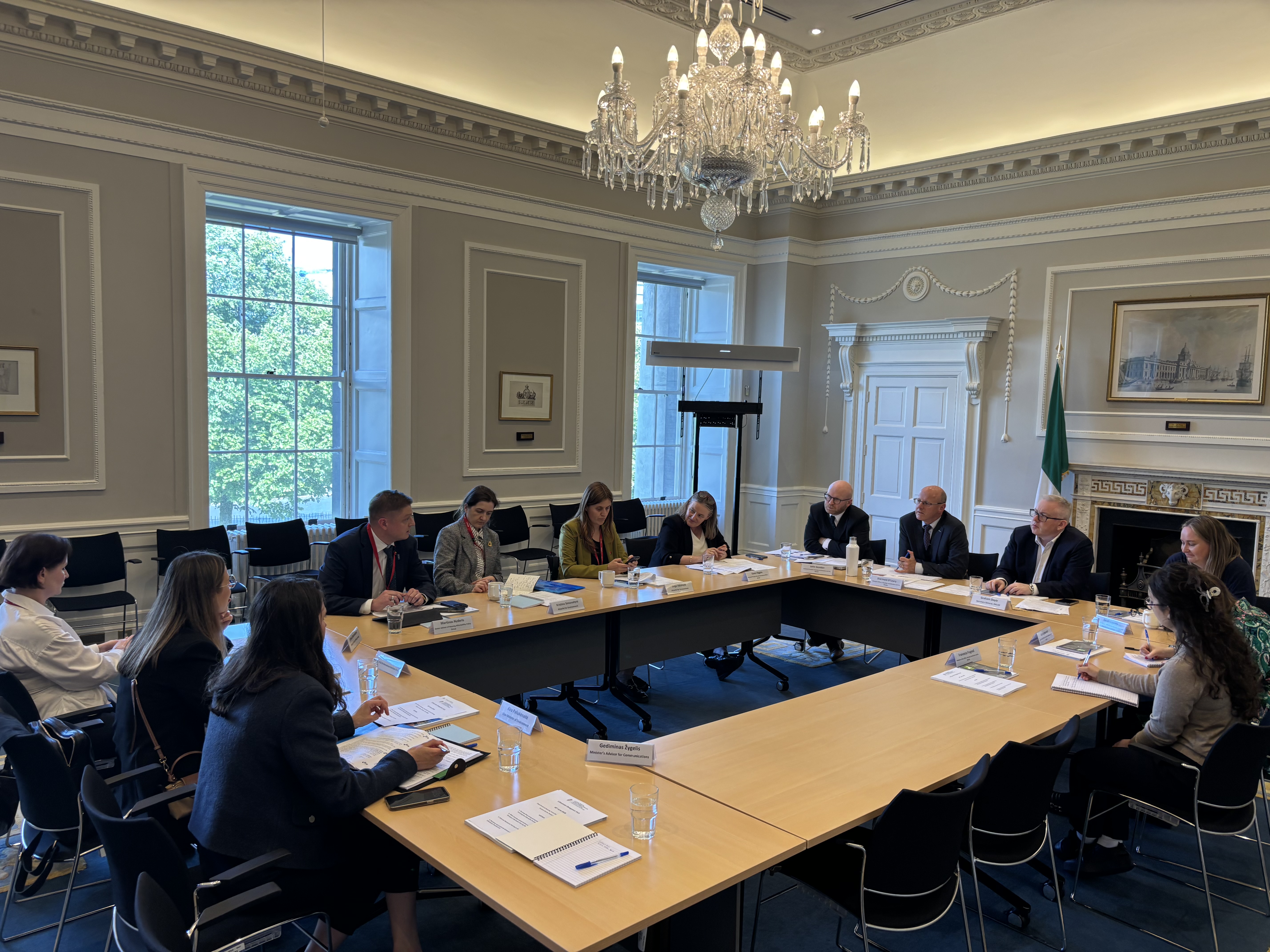
On 9 and 10 June, a Lithuanian delegation led by Vice-Minister of Environment Aira Paliukėnaitė visited Dublin to discuss preparations for Lithuania’s Presidency of the Council of the European Union in 2027 and the handover of priority environmental policy files from Ireland, which will hold the Presidency in the second half of 2026.
“As we prepare for Lithuania’s Presidency, we are seeking to identify in advance which EU legislative files may continue into the first half of 2027 and which areas will require closer coordination. With our Irish counterparts, we discussed climate policy, the circular economy, housing, forests, marine policy and environmental regulation, as well as practical cooperation to ensure a smooth handover of ongoing work,” said Vice-Minister A. Paliukėnaitė.
During the visit, the Lithuanian delegation met Niall Collins, Minister of State at Ireland’s Department of Agriculture, Food and the Marine with responsibility for forestry, as well as representatives of Irish institutions responsible for climate, energy, the environment, housing, local government, heritage, agriculture, food and marine affairs.
Housing policy was discussed separately, as it may become an important part of Lithuania’s Presidency agenda. The European Commission is currently preparing proposals on affordable housing, and Lithuania is therefore assessing how these initiatives may be considered in the Council and which files could continue into its Presidency.
“Housing affordability is a relatively new and increasingly important issue on the EU agenda. The matter is particularly relevant in Ireland, making its experience valuable as Lithuania prepares for the Presidency. We discussed how the forthcoming European Commission proposals on affordable housing could be taken forward in the Council and which measures could help deliver progress,” said A. Paliukėnaitė.
Discussions on EU climate policy covered the forthcoming review of the Emissions Trading System, the package expected to support the implementation of post-2030 climate targets and the planned climate resilience initiative. Lithuania stressed that climate objectives must be considered alongside their impact on businesses and industry, energy security and the capacity of Member States to implement the proposed measures.
The parties also discussed the Omnibus VIII package, aimed at reducing administrative burdens while maintaining high environmental standards, and the Circular Economy Act planned for 2026, which is expected to strengthen the market for secondary raw materials and reduce dependence on imports.
The Lithuanian delegation presented national policy developments, including the review of the Law on Forests, the preparation of a new forest strategy and emerging bioeconomy priorities. Lithuania underlined the need to balance forest use with biodiversity protection and the long-term viability of the sector.
In discussions on marine policy, Lithuania emphasised that the forthcoming European Oceans Act and the review of marine-related directives should be proportionate and take account of the specific characteristics of different regions.
The two countries also discussed Presidency-related work on international environmental processes affected by geopolitical challenges. These include negotiations on a global agreement to address plastic pollution, as well as international cooperation on climate change, chemicals and waste, oceans and other environmental matters.
Lithuania and Ireland agreed to continue exchanging information and working closely on the preparation of EU positions, while strengthening coordination throughout the Presidency handover process.
Last updated: 26-06-2026
Related news:
Lithuania’s Social Climate Plan aims to improve living conditions for vulnerable people
Baltic States and Poland strengthen cooperation on implementing energy and climate plans
Key provisions of the EU Packaging and Packaging Waste Regulation now apply
Algirdas Pieniuta takes office as Vice-Minister of Environment