

K. Žuromskas reviews nine months of progress, from completing land reform to reducing forest harvesting
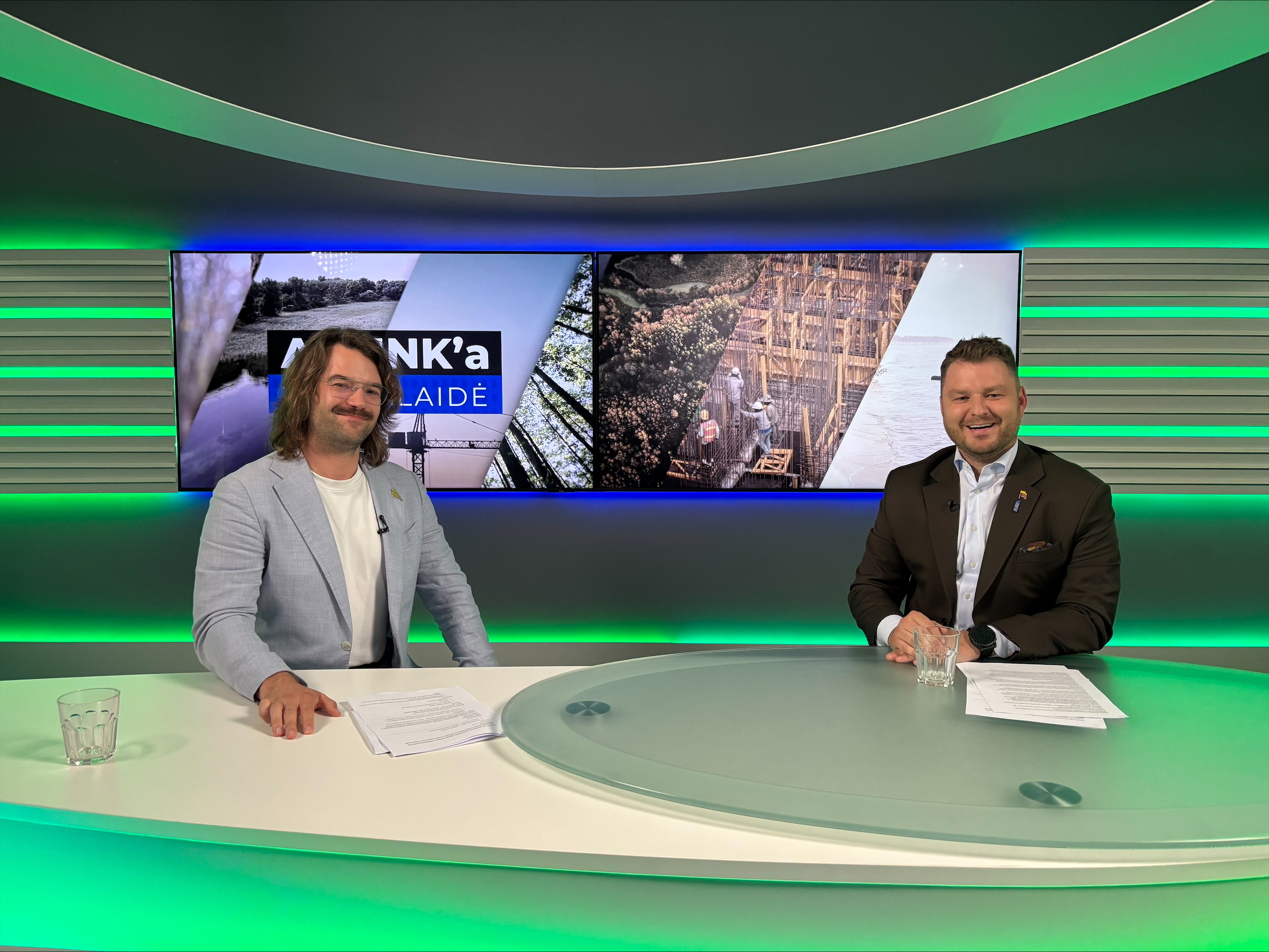
During the term of office of the 20th Government, the Ministry of Environment initiated significant reforms in housing, construction, climate policy, forest protection and public governance. Key measures include the completion of the land reform, the streamlining of construction procedures, stronger protection of forests and more than EUR 1.5 billion secured for climate-related investment.
“From the outset of the Government’s term last autumn, the Ministry’s work has focused on decisions that deliver measurable results and on open dialogue with municipalities, businesses, non-governmental organisations and other stakeholders. One example is the extensive consultation on forest harvesting, which resulted in an agreement to reduce the annual allowable cut in state forests by 10 per cent over the next two years,” said Acting Minister of Environment Kastytis Žuromskas.
According to the Acting Minister, the publication of accessible forest harvesting data has also strengthened public oversight. Residents can now verify whether felling in a particular area has been authorised and report suspected infringements to the competent supervisory authorities.
Another significant outcome was the agreement between the Ministry of Environment and the Ministry of National Defence on the protection of biodiversity in military training areas. The agreement provides EUR 400,000 for measures to reduce impacts on the natural environment. Decisions have also been taken to strengthen the protection of Dzūkija National Park and Labanoras Regional Park.
“Our efforts were directed towards ensuring that public administration operates more efficiently, procedures are simpler and more consistent, and the benefits of decisions are delivered without unnecessary delay. I hope that the future leadership of the Ministry will maintain this momentum, particularly in completing preparations for Lithuania’s Presidency of the Council of the European Union, during which the Ministry will be responsible for an exceptionally broad range of policy areas,” said the Acting Minister.
Climate policy measures include investment in housing affordability
This year, the European Commission approved Lithuania’s Social Climate Plan, making Lithuania one of the first EU Member States to reach this stage. The Plan provides for almost EUR 884 million in investment by 2032. More than EUR 422 million will be directed towards vulnerable households, including approximately EUR 270 million for the renovation of multi-apartment buildings. The funding will enable more than 37,000 dwellings to be renovated.
“The funding provided under the Social Climate Plan should primarily benefit the most vulnerable residents, who require the greatest support in adapting to climate change and strengthening their resilience. Approximately 80 per cent of the funding will be allocated to the regions, which should contribute to a substantial improvement in affordable housing outside Lithuania’s major cities,” said Mr Žuromskas.
More than EUR 700 million in investment from the Climate Change Programme and the Modernisation Fund is planned for 2026–2029. The funding will support the transition of households and businesses towards less polluting technologies, improve energy efficiency and reduce climate-related impacts.
Balancing nature conservation and national defence requirements
The Ministry of Environment made a substantial contribution to the preparation of legislation establishing the Kapčiamiestis military training area and expanding the Tauragė training area. The legislation includes safeguards designed to protect the natural environment both within and beyond the boundaries of the training areas.
The Ministry of Environment, the Ministry of National Defence and the State Service for Protected Areas also concluded a joint agreement setting out biodiversity protection measures in military training areas and the arrangements for financing them.
“We have introduced safeguards that will allow national defence requirements to be met while protecting the natural environment. Where environmental impacts cannot be avoided, they will be compensated for through restoration measures or the establishment of additional protected areas. The necessary funding will be provided from national defence appropriations,” said Mr Žuromskas.
The allocated funding will enable approximately 1,000 hectares of forest to be replanted outside the Kapčiamiestis military training area. A further EUR 200,000 has been earmarked for peatland restoration, with restored wetlands also serving as counter-mobility measures. Particular attention will be given to monitoring and protecting the capercaillie population. The measures will be implemented between 2026 and 2029 to support the long-term ecological balance of the area.
Streamlining construction and housing procedures
The Ministry of Environment has prepared and submitted to the Seimas amendments to the Law on Construction and five related laws. The proposed changes are intended to simplify the issuance of building permits, shorten project approval periods, automate procedures, reduce the administrative burden on housing developers and define the responsibilities of participants in the construction process more clearly.
“The proposed legislative amendments provide for the substantial digitalisation of building permit procedures, saving both time and financial resources. We estimate that the annual administrative burden on residents and businesses will be reduced by approximately EUR 1.5 million. Municipalities are expected to save around EUR 3.5 million annually by discontinuing the initial review of design solutions,” said Mr Žuromskas.
The amendments will also contribute to the implementation of the European Parliament and Council Directive on the energy performance of buildings, further reduce greenhouse gas emissions, promote the modernisation of buildings and support the gradual transition towards a zero-emission building stock.
The draft Law on the Real Estate Cadastre is expected to remove unnecessary administrative obstacles to the implementation of national defence projects and other projects of national importance.
Completing the decades-long land reform
Measures initiated by the Ministry of Environment will enable Lithuania to complete one of its longest-running reforms. From 2027, responsibility for the administration of state-owned land in rural areas will be transferred to municipalities.
“Municipalities will be able to take decisions concerning the lease, transfer for use and development of state-owned land, as well as the management of abandoned areas. Mayors can already begin planning the future use of the land and preparing for auctions. To mitigate corruption risks, decisions concerning certain state-owned land lease and use transactions will require coordination with the National Land Service in the cases specified in the Law on Land. Nevertheless, procedures affecting residents and businesses will be completed more quickly and closer to the communities concerned,” said Mr Žuromskas.
Greater transparency and more effective governance
Over the past nine months, the Ministry of Environment has reorganised its internal structure, conducted audits of institutions under its remit and begun optimising their operations. A centralised information systems development unit has been established, and a range of administrative procedures have been digitalised.
For the first time, the public has access to data updated daily on all forest felling permits issued for state and private forests, statistics on building permits and information on transactions involving the lease and use of state-owned land.
“Open data provide a basis for better-informed decisions. Once information on delays in the issuance of building permits by individual municipalities was made public, the matter received greater attention and performance improved. The publication of data also encouraged municipalities to exchange experience and coordinate planning with neighbouring local authorities,” said Mr Žuromskas.
Improving housing affordability
A comprehensive assessment of housing affordability in Lithuania, commissioned by the Ministry, is expected to form the basis of the National Housing Affordability Strategy. For the first time, the assessment provided an integrated analysis of differences in housing affordability between Lithuanian municipalities and identified long-term measures to address them.
The Ministry has also intensified cooperation with municipalities on the development of municipal housing and prepared a National Renovation Plan. A new target has been set to increase the number of renovated multi-apartment buildings by at least 10 per cent each year. The introduction of industrialised renovation using prefabricated panels is also expected to accelerate renovation.
Progress on the demolition of the Moscow House
The long-delayed process of demolishing the so-called Moscow House in Vilnius has moved forward after the Ministry of Environment, Vilnius City Municipality and other partners identified a legal solution. A decision has been taken to write off the building as an asset and transfer it to Vilnius City Municipality, enabling the Municipality to proceed with the demolition.
Podcast link: