

Lithuania to take the helm of the Council of the EU in 2027: what environmental policy work lies ahead?
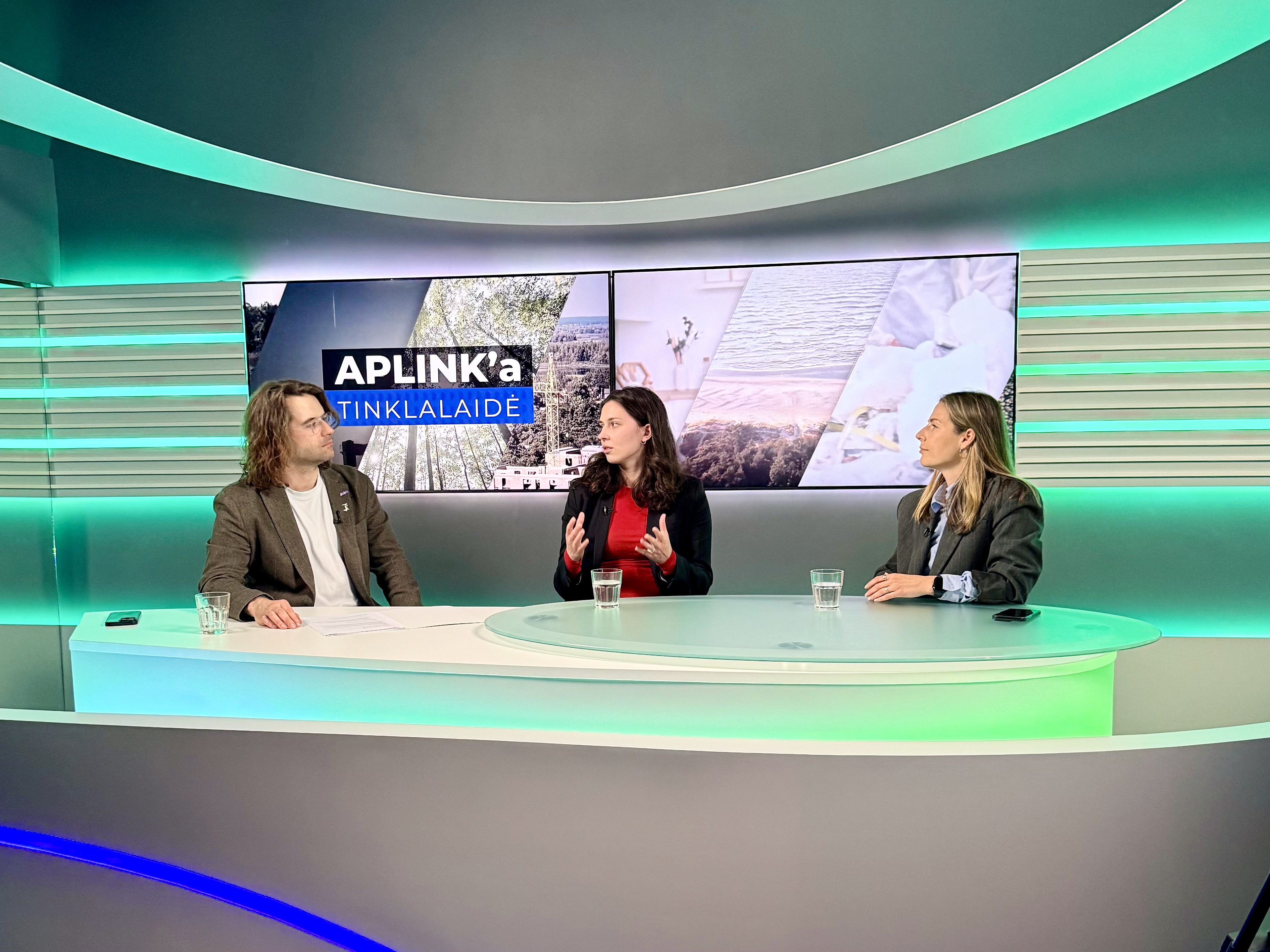
In the first half of 2027, Lithuania will hold the Presidency of the Council of the European Union (EU) for the second time. The Ministry of Environment’s podcast “APLINK'a” presents how the Ministry’s staff are preparing for this period, what functions will fall to the presiding Member State and which environmental policy issues may be considered during the Presidency.
Member States hold the Presidency of the Council of the EU on a rotating basis, with each Presidency lasting six months. During this period, the presiding country organises the work of the Council, chairs meetings, coordinates the positions of Member States, moderates discussions and seeks common agreement on EU legislative and political decisions.
“Presiding over the Council essentially means that, for six months, we take the wheel in determining the direction and pace at which the European Union moves on environmental issues. Put simply, we will be responsible not only for our national interest, but also for seeking a common agreement that works for all 27 Member States. This is quite a complex task,” said Eimantė Lastovkaitė, Head of the EU and International Relations Group at the Ministry of Environment.
The Ministry of Environment is preparing for the Presidency by assessing the European Commission’s agenda and planned legislative initiatives in the field of environment. At the same time, teams responsible for Presidency-related work are being formed, their functions are being assigned, and work is being planned at both expert and political levels.
According to Vice-Minister of Environment Aira Paliukėnaitė, some of the possible agenda items will be related to climate policy, climate adaptation and the circular economy.
“Among the specific documents we expect to examine during our Presidency, several are related to climate issues: the review of emission allowances, the full package for implementing the 2040 climate target, climate adaptation, to which we pay considerable attention at national level because of floods, droughts and soil erosion, as well as the Circular Economy Act and its accompanying documents,” said A. Paliukėnaitė.
The podcast also discussed how environmental policy issues are increasingly linked to broader EU priorities: security, resilience and competitiveness. This is relevant to climate policy, the circular economy, waste reduction, the use of secondary raw materials and adaptation to climate change.
“Among the priorities, first and foremost, are security, ensuring it, increasing resilience and competitiveness, and all of this is closely linked to environmental protection,” said E. Lastovkaitė.
The results of the Presidency will be assessed based on progress in the work of the Council of the EU: agreements reached among Member States, coordinated common positions and a smooth legislative process.
“The concrete results achieved during our Presidency will be the measure of success,” said A. Paliukėnaitė.
Lithuania first held the Presidency of the Council of the EU from 1 July to 31 December 2013. Lithuania’s second Presidency will take place from 1 January to 30 June 2027. Lithuania will work in a Presidency trio with Ireland and Greece: Ireland will hold the Presidency before Lithuania, and Greece will take over after Lithuania. The trio prepares a common 18-month agenda, while each country develops its own six-month programme based on it.
The full recording of the “APLINK'a” podcast is available here:
Last updated: 22-06-2026
Related news:
Lithuania’s Social Climate Plan aims to improve living conditions for vulnerable people
Baltic States and Poland strengthen cooperation on implementing energy and climate plans
Key provisions of the EU Packaging and Packaging Waste Regulation now apply
Algirdas Pieniuta takes office as Vice-Minister of Environment