

Lithuania's renewable energy deployment practices showcased as exemplary at United Nations forum
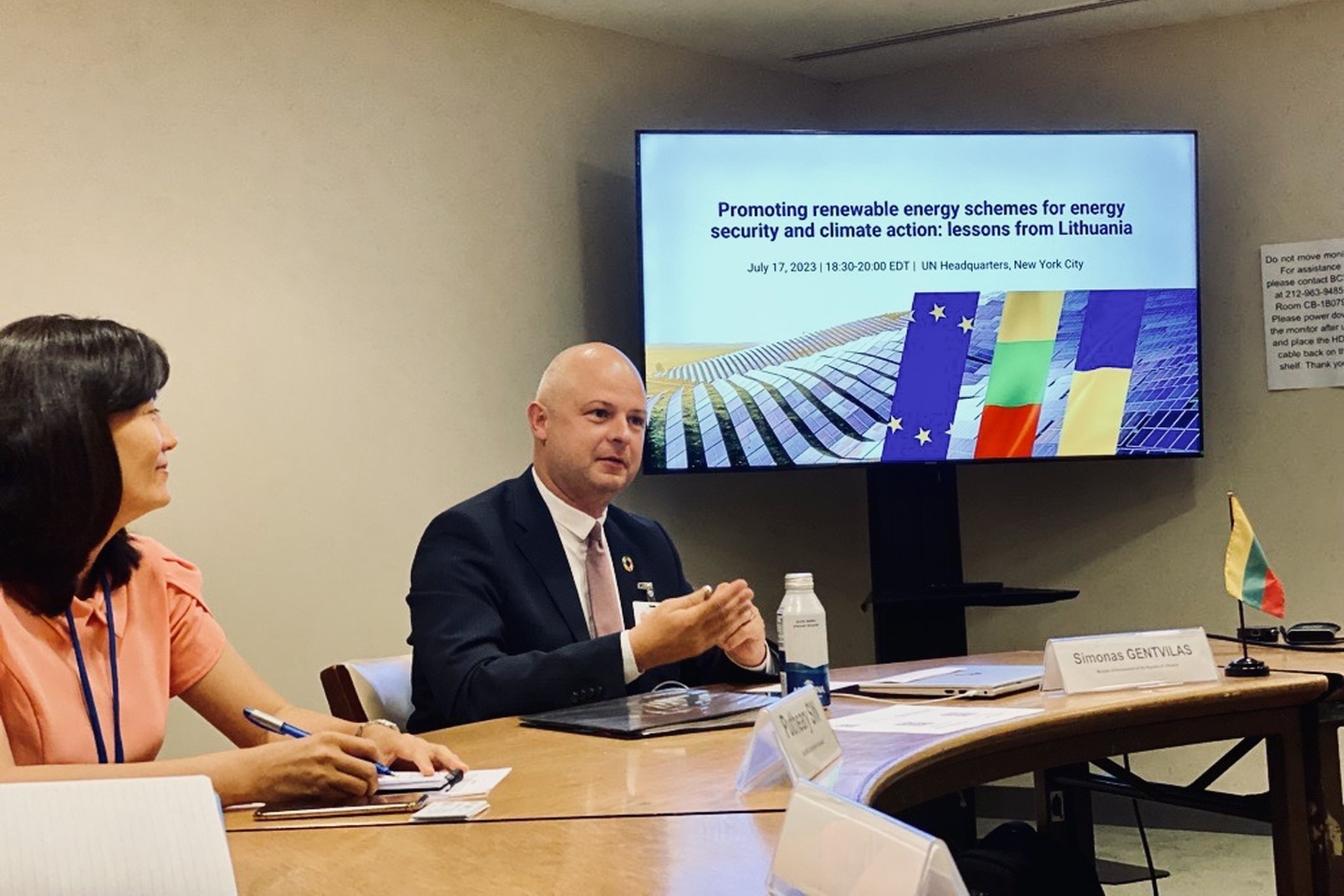
Minister of the Environment Simonas Gentvilas shared Lithuania's successful initiatives in promoting renewable energy at the United Nations High-Level Political Forum on Sustainable Development in New York. Organized by the Permanent Mission of the Republic of Lithuania to the United Nations and the National Platform of Non-Governmental Organizations for Development Cooperation, the discussion showcased Lithuania's effective implementation of the "producer-consumer" scheme, encouraging widespread adoption of renewable energy measures among the populace.
The forum, moderated by Kęstutis Kupšys, Vice President of the Consumer Alliance and member of the European Economic and Social Committee, featured sustainable energy experts from the USA, Spain, Cambodia, and Tanzania, with Ireland's Minister for Environment, Climate, and Transport, Eamon Ryan, also in attendance.
Minister Gentvilas informed his international counterparts that the number of consumers producing energy in Lithuania has tripled over the past three years. This remarkable growth is attributed to changes in the legislative framework, state support, and collaborative projects with residents.
Gentvilas emphasized Lithuania's commitment to simplifying the legislative framework to facilitate the installation of renewable energy sources. In 2022 alone, positive decisions on environmental impact assessments were granted for 197 wind farms, with a total installed capacity of around 1,370 MW. The Ministry of the Environment has also compiled a list of the most sensitive bird species affected by wind farms and established the appropriate distance from their breeding grounds for the installation of such farms.
To expedite the development of solar power plants, the Ministry of the Environment introduced environmental requirements for planning, construction, and operation. These standardized requirements enable faster issuance of permits for solar projects.
Financial support was identified as a key driver for renewable energy development, with Lithuania planning to invest €1 billion by 2030. This includes allocations of €389 million to promote household energy self-sufficiency, €52.2 million to reduce energy poverty, €234.1 million for transitioning businesses to green energy, and €300.9 million to enhance energy production and efficiency.
The discussion also delved into strategies for accelerating the deployment of renewable energy technologies by fostering collaboration with the population. The CLEAR-X project, funded by the European Union and implemented by the Consumers' Alliance, was highlighted as an example. This initiative organizes collective purchases, urging consumers to join forces for the acquisition of remote solar power plants or rooftop installations under favorable conditions. Certified installers work directly with consumer organizations to ensure trustworthy services.
At the New York Forum, Lithuania's Minister for the Environment underscored the significance of promoting the "Producer-Consumer" mechanism, emphasizing its role in advancing goals such as poverty reduction, access to clean energy, and climate impact mitigation across diverse social contexts.
The United Nations Policy Forum on Sustainable Development, currently in session in New York, serves as the primary international policymaking body on sustainable development, regularly assessing countries' progress in this domain. Lithuania is set to present its comprehensive report on sustainable development at the event.
Last updated: 09-01-2024
Related news:
Lithuania’s Social Climate Plan aims to improve living conditions for vulnerable people
Baltic States and Poland strengthen cooperation on implementing energy and climate plans
Key provisions of the EU Packaging and Packaging Waste Regulation now apply
Algirdas Pieniuta takes office as Vice-Minister of Environment